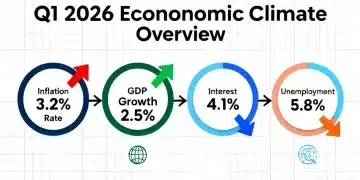
Tech Advancements & U.S. Productivity by 2026

Technological advancements are poised to profoundly transform U.S. productivity by 2026, driving efficiency, reshaping industries, and influencing economic growth across various sectors.
Are you ready to explore how cutting-edge innovations will redefine the American economic landscape in the near future? The trajectory of technological advancements and their economic impact on U.S. productivity by 2026 is not just a topic for futurists; it’s a pressing reality for businesses, policymakers, and individuals alike. This article delves into the transformative power of emerging technologies, examining how they are set to revolutionize industries, reshape the labor market, and ultimately drive the nation’s economic output to unprecedented levels.
The AI Revolution: A Catalyst for U.S. Productivity Growth
Artificial Intelligence (AI) stands at the forefront of the current technological revolution, promising unparalleled shifts in how businesses operate and how work is performed. By 2026, AI is expected to be deeply embedded across various sectors of the U.S. economy, acting as a significant catalyst for productivity growth. Its ability to automate complex tasks, analyze vast datasets, and provide predictive insights will unlock efficiencies previously unattainable.
The integration of AI into operational workflows is not merely about replacing human labor; it’s about augmenting human capabilities, allowing for more strategic decision-making and fostering innovation. From supply chain optimization to personalized customer experiences, AI’s reach is broad and its potential impact on productivity profound.
AI in Manufacturing and Logistics
In manufacturing, AI-powered robotics and predictive maintenance systems are already enhancing production efficiency and reducing downtime. Logistics benefits from AI through optimized routing, demand forecasting, and autonomous delivery systems, streamlining the movement of goods.
- Automated quality control systems identifying defects with greater accuracy.
- Predictive maintenance reducing equipment failures and extending asset lifespans.
- Optimized supply chain management minimizing waste and improving delivery times.
The synergy between AI and human workers in these sectors will lead to a more agile and responsive industrial base, capable of adapting quickly to market demands and global shifts. This increased adaptability is a direct contributor to overall economic productivity.
AI in Services and Knowledge Work
The service sector, a major component of the U.S. economy, is also undergoing significant AI-driven transformation. AI tools are enhancing customer service through intelligent chatbots, streamlining administrative tasks, and providing data-driven insights for marketing and sales strategies. In knowledge-intensive fields, AI assists with research, content creation, and complex problem-solving, freeing up human experts to focus on higher-value activities.
By 2026, the pervasive adoption of AI in these areas will lead to a substantial uplift in output per worker, redefining job roles and demanding new skill sets from the workforce. The focus will shift from repetitive tasks to creative and critical thinking, further boosting productivity.
Automation and Robotics: Reshaping Industrial Landscapes
Beyond AI, the advancements in automation and robotics are fundamentally altering the industrial landscape of the United States. These technologies are not confined to large-scale manufacturing plants; they are increasingly accessible to small and medium-sized enterprises (SMEs), allowing for widespread adoption and a broader impact on national productivity.
The precision, speed, and tireless nature of robotic systems enable higher production volumes, consistent quality, and safer working environments. This translates directly into increased output and reduced operational costs, both critical components of productivity growth.
The Rise of Collaborative Robotics
Collaborative robots, or ‘cobots,’ are designed to work alongside humans, augmenting their capabilities rather than replacing them entirely. This collaborative approach allows businesses to leverage the strengths of both humans and machines, leading to optimized workflows and enhanced efficiency.
- Improved safety in shared workspaces.
- Increased flexibility in production lines.
- Enhanced precision for intricate tasks.
The deployment of cobots is making automation more palatable and accessible for industries that previously relied heavily on manual labor, facilitating a smoother transition into a more automated future. This integration is crucial for maintaining a competitive edge in global markets.
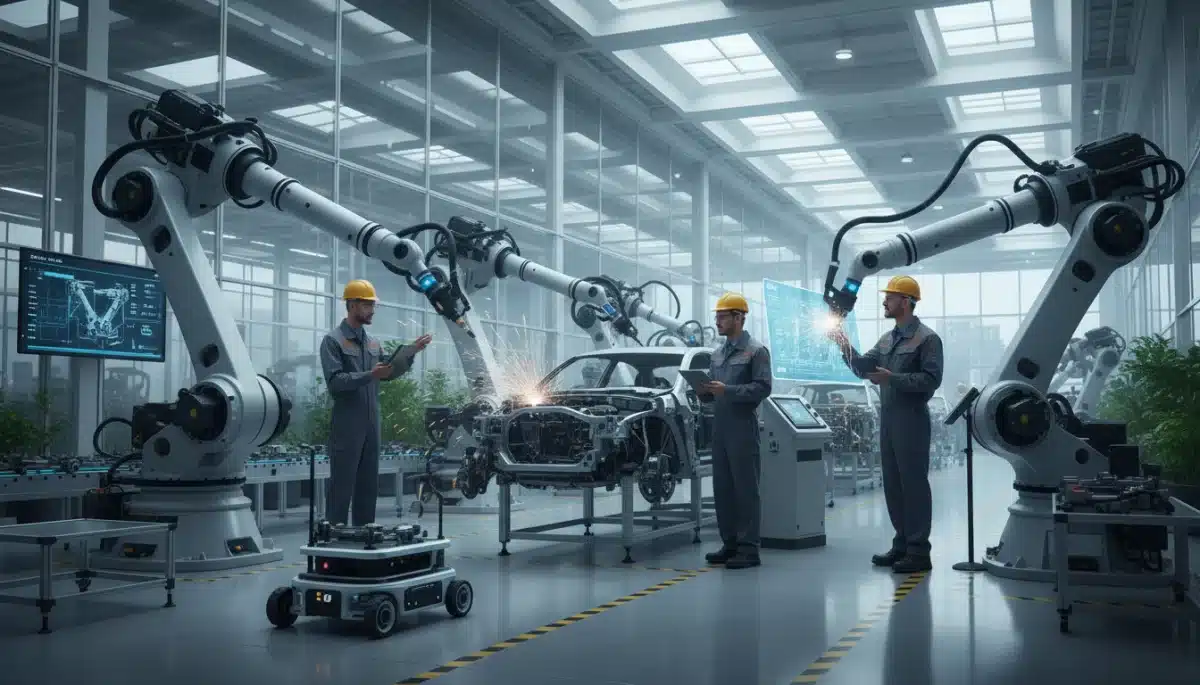
The impact of automation extends beyond the factory floor. In logistics, warehouses are becoming increasingly automated with autonomous mobile robots (AMRs) handling sorting, picking, and packing tasks. In agriculture, robotic systems are performing precision planting, harvesting, and pest control, leading to higher yields and reduced resource consumption. These advancements contribute to a more resilient and productive economy.
The Internet of Things (IoT) and Data-Driven Efficiency
The proliferation of the Internet of Things (IoT) is creating an interconnected web of devices, sensors, and systems that generate vast amounts of data. This data, when properly analyzed, provides invaluable insights that drive efficiency and productivity across sectors. By 2026, IoT will be a cornerstone of smart infrastructure, smart manufacturing, and smart cities, optimizing resource utilization and improving operational performance.
The ability to monitor, analyze, and control physical assets remotely and in real-time allows businesses to preempt issues, optimize processes, and make informed decisions, leading to significant gains in productivity and cost savings.
Smart Manufacturing with IoT
In manufacturing, IoT sensors embedded in machinery provide real-time data on performance, enabling predictive maintenance and optimizing production schedules. This reduces downtime, improves asset utilization, and ensures higher quality output.
- Real-time performance monitoring of equipment.
- Automated inventory management based on consumption data.
- Enhanced supply chain visibility and traceability.
The insights derived from IoT data empower manufacturers to create more efficient and responsive production systems, capable of adapting to fluctuating demands and minimizing waste. This data-driven approach is a key driver of productivity in the industrial sector.
IoT in Urban and Agricultural Settings
Beyond industry, IoT is transforming urban environments and agriculture. Smart city initiatives leverage IoT to manage traffic flow, optimize energy consumption, and improve public safety. In agriculture, IoT sensors monitor soil conditions, weather patterns, and crop health, enabling precision farming practices that maximize yields while minimizing water and fertilizer usage.
These applications of IoT are not only enhancing productivity but also contributing to sustainability efforts, creating a more resource-efficient and economically robust nation. The continuous flow of data from these interconnected systems provides a feedback loop for continuous improvement.
Advanced Connectivity: 5G and Beyond
The backbone of many of these technological advancements is robust and high-speed connectivity. The widespread deployment of 5G networks, and the impending advancements beyond it, are crucial enablers for the full realization of AI, IoT, and advanced automation. By 2026, ubiquitous and low-latency connectivity will unlock new possibilities for remote operations, real-time data processing, and immersive digital experiences.
Faster and more reliable networks facilitate instant communication between devices, support complex cloud-based applications, and enable the seamless operation of autonomous systems. This enhanced connectivity is not just an incremental improvement; it’s a foundational shift that accelerates productivity gains across all sectors.
Enabling Edge Computing and Cloud Integration
5G’s low latency makes edge computing more viable, allowing data to be processed closer to its source, reducing delays and improving responsiveness. This is critical for applications like autonomous vehicles and real-time industrial control systems. Simultaneously, enhanced connectivity strengthens cloud integration, enabling businesses to leverage scalable computing resources and advanced analytics platforms more effectively.
- Faster data transmission for critical applications.
- Improved reliability for remote operations.
- Support for massive numbers of connected devices.
The synergy between advanced connectivity, edge computing, and cloud platforms creates a powerful ecosystem that drives innovation and efficiency, directly contributing to higher productivity levels throughout the U.S. economy.
Impact on Remote Work and Digital Collaboration
The COVID-19 pandemic accelerated the adoption of remote work, and advanced connectivity is making it a more permanent and productive fixture of the modern economy. High-speed, reliable internet enables seamless digital collaboration, virtual meetings, and access to cloud-based tools, maintaining or even enhancing productivity for distributed teams.
By 2026, remote and hybrid work models, supported by superior connectivity, will offer businesses greater flexibility, access to a wider talent pool, and potentially reduced overhead costs, all of which contribute to overall economic productivity.
Quantum Computing and Biotechnology: Emerging Drivers
While AI, automation, IoT, and 5G are already having a significant impact, emerging technologies like quantum computing and advancements in biotechnology are poised to become increasingly important drivers of U.S. productivity by 2026 and beyond. These fields, though still in earlier stages of commercialization, hold the promise of revolutionary breakthroughs that could fundamentally change industries and scientific research.
Quantum computing, with its potential to solve problems intractable for classical computers, could accelerate drug discovery, materials science, and financial modeling. Biotechnology, particularly in areas like synthetic biology and gene editing, offers solutions for healthcare, agriculture, and sustainable manufacturing, leading to new products and processes that enhance economic output.
Quantum Computing’s Transformative Potential
Quantum computers leverage the principles of quantum mechanics to perform calculations at speeds and scales far beyond traditional supercomputers. By 2026, while widespread commercial adoption may still be nascent, advancements in quantum research will begin to yield practical applications, particularly in complex optimization problems and cryptographic security.
- Accelerated drug discovery and personalized medicine.
- Development of new materials with superior properties.
- Enhanced financial modeling and risk assessment.
The ability of quantum computing to tackle previously unsolvable problems will open up new avenues for innovation and efficiency, creating entirely new industries and significantly boosting productivity in existing ones.
Biotechnology’s Contribution to Economic Output
Biotechnology is rapidly advancing, offering solutions that range from novel therapeutics to sustainable energy sources. By 2026, advancements in areas like CRISPR gene editing, bioinformatics, and biomanufacturing will lead to more effective treatments, higher-yield crops, and environmentally friendly industrial processes.
These innovations will not only improve quality of life but also create new economic sectors, enhance resource efficiency, and reduce the environmental footprint of production, all contributing to a more productive and sustainable U.S. economy. The convergence of biotechnology with AI and automation will further amplify its impact.
Policy and Investment: Fueling the Future of Productivity
The realization of these technological benefits for U.S. productivity by 2026 is not solely dependent on innovation itself, but also on the supportive ecosystem of policy and investment. Government initiatives, private sector funding, and educational reforms play a critical role in fostering an environment where these advancements can thrive and translate into tangible economic gains.
Strategic investments in research and development, alongside policies that encourage technology adoption and workforce retraining, are essential to maximize the positive impact of these technologies and mitigate potential disruptions.
Government Initiatives and R&D Funding
Federal and state governments are increasingly recognizing the importance of technological leadership. Funding for basic and applied research in areas like AI, quantum computing, and biotechnology is crucial. Policies that incentivize private sector R&D and facilitate technology transfer from academia to industry will accelerate innovation.
- Increased federal grants for cutting-edge research.
- Tax incentives for private sector innovation.
- Streamlined regulatory frameworks for emerging technologies.
These initiatives ensure that the U.S. remains at the forefront of technological development, creating a pipeline of innovations that will drive future productivity growth.
Workforce Development and Education
As technology reshapes job roles, investing in workforce development and education is paramount. Programs that focus on digital literacy, STEM skills, and continuous learning will equip the American workforce with the competencies needed to thrive in an increasingly automated and AI-driven economy. This includes reskilling and upskilling initiatives for workers in industries undergoing significant transformation.
By proactively addressing the skills gap, the U.S. can ensure that its human capital remains a competitive advantage, capable of leveraging new technologies to enhance productivity. Education and training are key to unlocking the full potential of technological advancements.
| Key Impact Area | Brief Description |
|---|---|
| AI Integration | Automates tasks, analyzes data, and provides insights for efficiency across sectors. |
| Automation & Robotics | Increases production speed, quality, and safety in manufacturing and logistics. |
| IoT & Data Analytics | Connects devices for real-time monitoring and data-driven operational optimization. |
| Advanced Connectivity | 5G and future networks enable faster data, remote operations, and digital collaboration. |
Frequently Asked Questions About Tech and U.S. Productivity
AI will primarily boost U.S. productivity by automating repetitive tasks, enhancing data analysis for better decision-making, and optimizing complex processes across various industries. It will augment human capabilities, allowing for greater focus on innovation and strategic initiatives, leading to more efficient resource utilization.
5G will provide the high-speed, low-latency connectivity essential for the widespread adoption of IoT devices, real-time data processing, and advanced automation. This enables more efficient remote operations, seamless cloud integration, and robust digital collaboration, all critical for driving productivity gains across the U.S. economy.
While automation may displace some jobs, the primary impact is expected to be a shift in job roles, requiring new skills. Automation often creates new jobs in technology development, maintenance, and data analysis. Workforce retraining and education initiatives are crucial to ensure a smooth transition and leverage human-machine collaboration for overall productivity growth.
Businesses should invest in digital infrastructure, embrace continuous learning for their workforce, and explore pilot programs for emerging technologies. Fostering a culture of innovation and adaptability, along with strategic partnerships, will be key to successfully integrating these advancements and capitalizing on their productivity-enhancing potential.
While many sectors will benefit, the degree of impact may vary. Industries like manufacturing, logistics, and technology will likely see more immediate and profound changes. However, even traditional sectors like agriculture and healthcare are poised for significant productivity gains through precision technology and data-driven solutions, leading to broad economic uplift.
Conclusion
The journey towards 2026 promises a dynamic transformation of U.S. productivity, largely driven by the relentless march of technological advancements. From the pervasive influence of AI and automation to the foundational support of advanced connectivity and the emerging potential of quantum computing and biotechnology, the landscape of work and economic output is rapidly evolving. Strategic investment, proactive policy-making, and a commitment to workforce development will be crucial in harnessing these innovations to ensure sustained economic growth and a more efficient, resilient, and prosperous American future. The synergy between human ingenuity and technological prowess will undoubtedly redefine what is possible, pushing the boundaries of productivity to new heights.
Autor